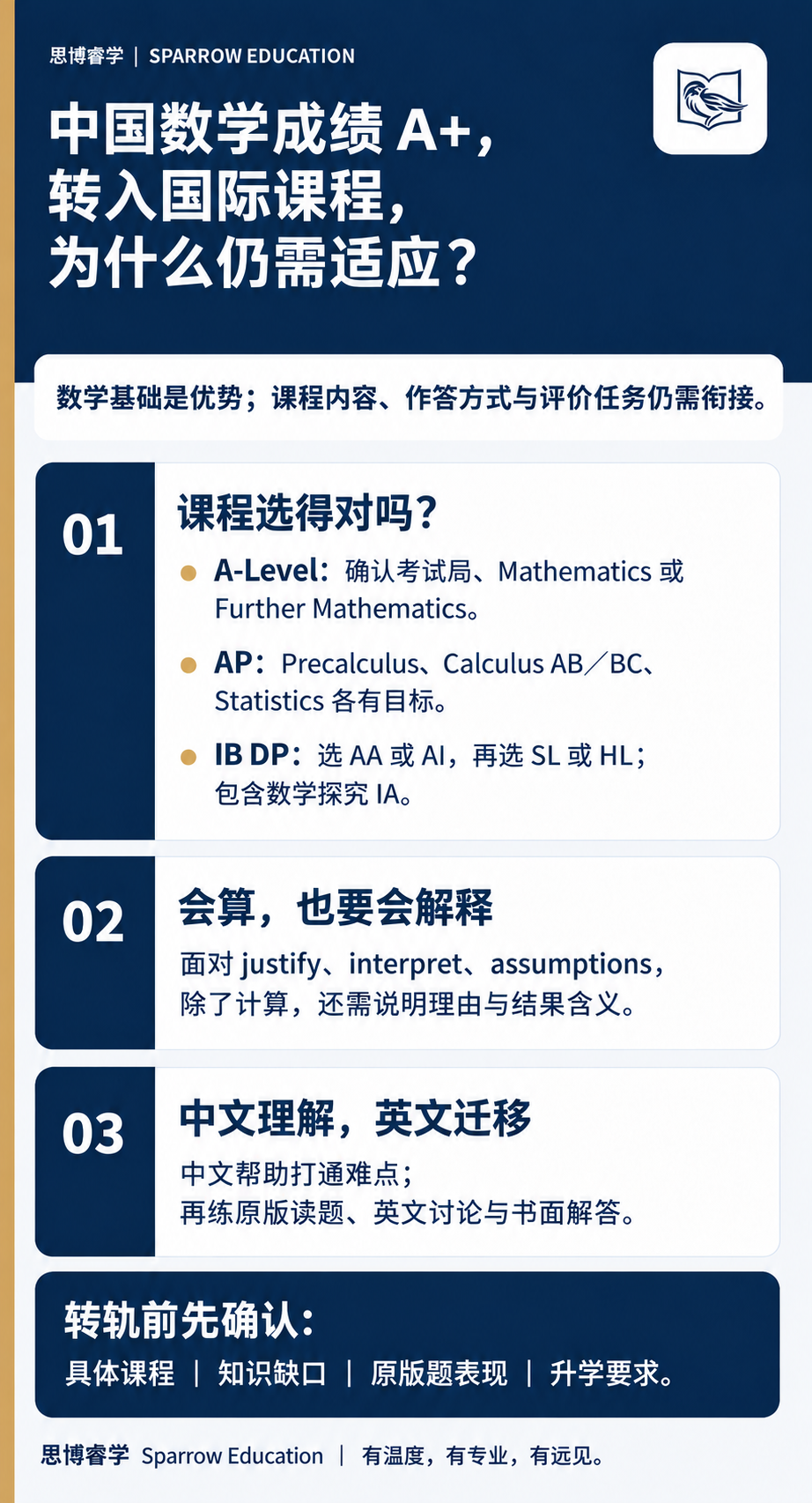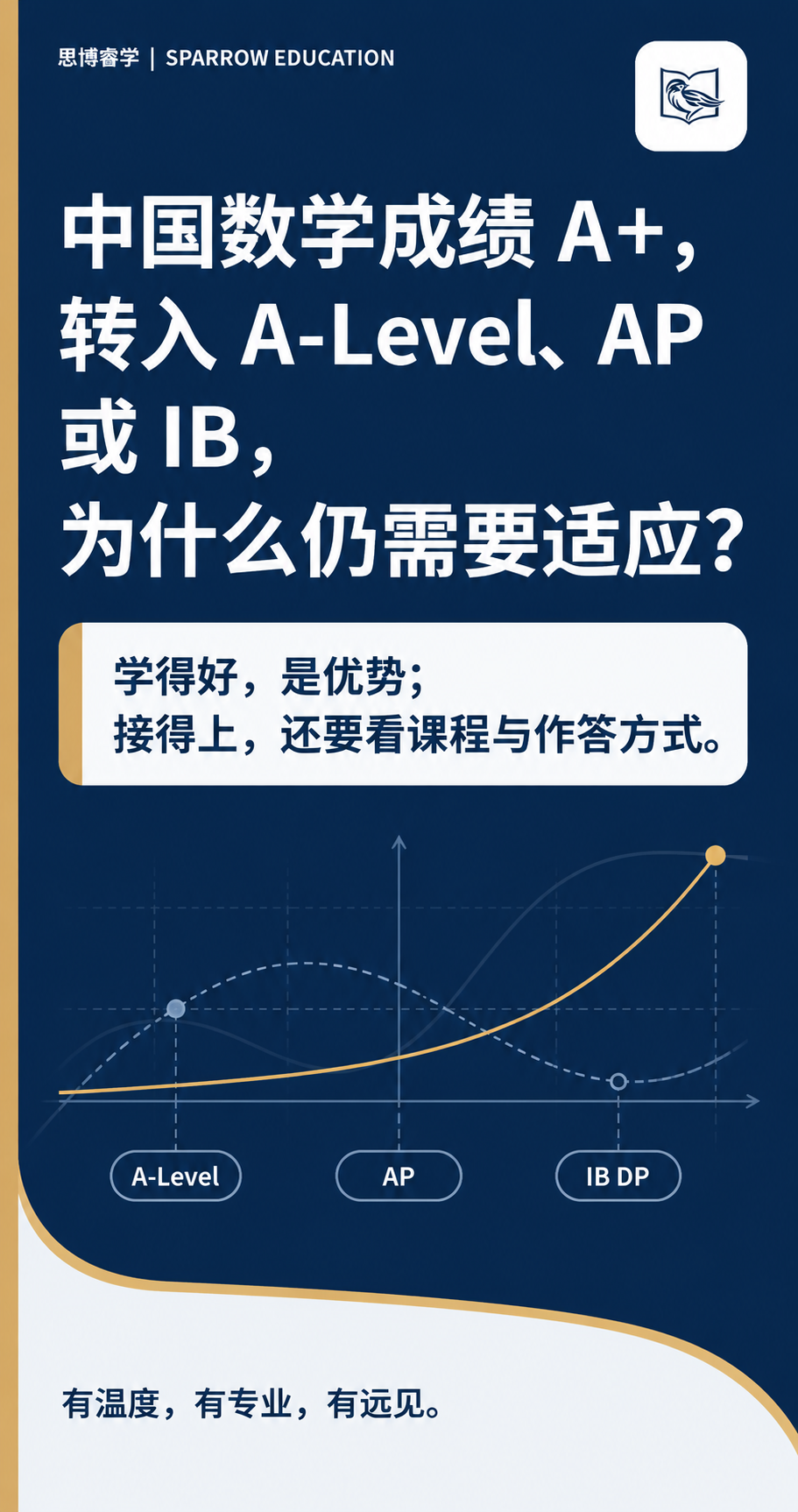
An A+ in maths: why is adjustment still needed when changing curricula?
How do A-Level, AP and IB mathematics differ from Chinese upper-secondary mathematics?
Chinese upper-secondary mathematics follows a relatively unified curriculum framework, with an emphasis on functions, algebra, geometry, probability and statistics, as well as reasoning, modelling and data analysis. Students typically receive systematic practice in problems that combine topics and in solving problems under time limits.
For A-Level mathematics, first confirm the examination board and subject. Mathematics covers pure mathematics and applied topics such as statistics and mechanics; Further Mathematics is a separate, more advanced course. The syllabuses offered by different examination boards, and those for Mathematics and Further Mathematics, should not be treated as interchangeable.
AP mathematics is not a single comprehensive course. AP Precalculus, Calculus AB/BC and Statistics each cover different content. Being proficient in calculus does not mean a student has also mastered statistical inference.
In IB DP mathematics, students choose between AA (Analysis and Approaches) and AI (Applications and Interpretation), then select SL or HL. AA places greater emphasis on analysis and abstract reasoning; AI places greater emphasis on context, modelling, statistics and the use of technology. IB mathematics also includes an individual mathematical exploration (IA), in which students must clearly present their mathematical thinking.
The differences therefore cannot be summed up as “Chinese mathematics is difficult; international mathematics is easy.” A student may be strong in algebraic calculations while still needing to learn statistical interpretation, mathematical exploration or methods for unfamiliar types of problems.
What is the difference between teaching mathematics in Chinese and teaching entirely in English?
Explaining new concepts in Chinese can help students understand derivations quickly and connect their existing mathematical foundation to the new curriculum. This can be an effective form of teaching support.
However, if explanations are consistently given only in Chinese and English is used only for exercises after class, students may be able to understand a question without being able to explain their reasoning clearly. When questions involve terms such as justify (give reasons), interpret (explain in context) or assumption (a modelling assumption), correct calculation is only part of the answer.
Teaching entirely in English gives students regular exposure to definitions and questions in their original English wording and ways of expressing ideas, but it does not automatically supply mathematical knowledge they have not yet learnt. The language of instruction should support mathematical understanding and assessment goals: explain difficult points thoroughly in Chinese when needed, then gradually have students read questions, discuss methods and write their answers in English. A-Level courses require students to communicate reasoning and explain models; IB mathematics assessments also have specific requirements regarding the language used in answers.
Related posters (original Chinese)