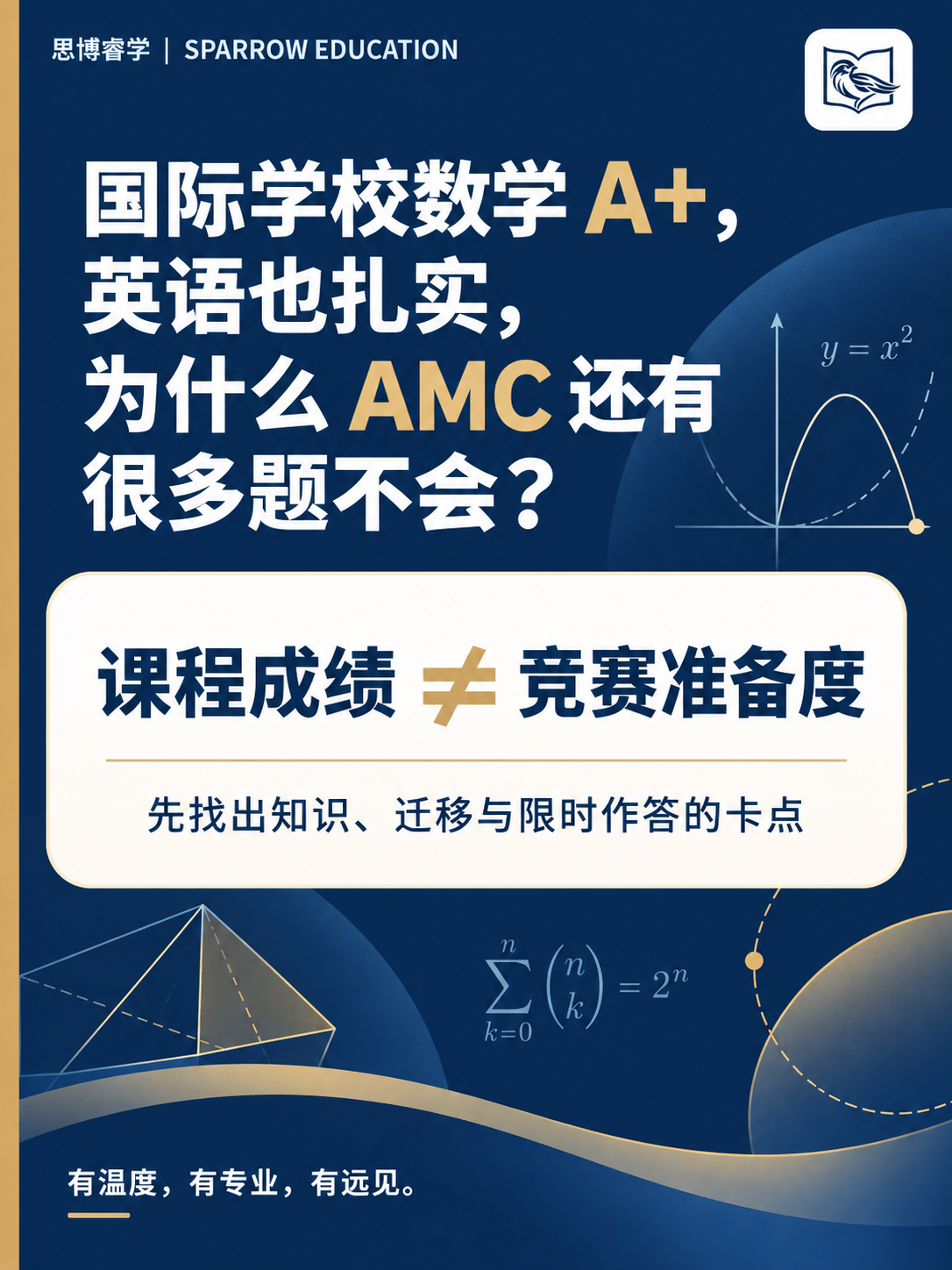
An A+ in international-curriculum maths: why are many AMC questions still difficult?
A real example: why can students with strong English still struggle with maths competition questions?
The students we have worked with attend a well-known school in Shanghai and have a strong foundation in English. Their current mathematics lessons are taught in Chinese by Chinese teachers, followed by exercises in English. They are studying foundational content for American maths competitions, including algebra, geometry, number theory, counting and probability.
They have already taken part in maths competitions, but have not yet completed all the foundational material and encounter many questions they cannot answer. The school has its own educational reasons for having Chinese teachers teach maths in Chinese, and there is good reason to trust those teachers' expertise. Parents want to understand why their children, who have strong English and have been studying maths for competitions, still struggle with many competition questions. Where exactly are they getting stuck, and how can those difficulties be addressed effectively?
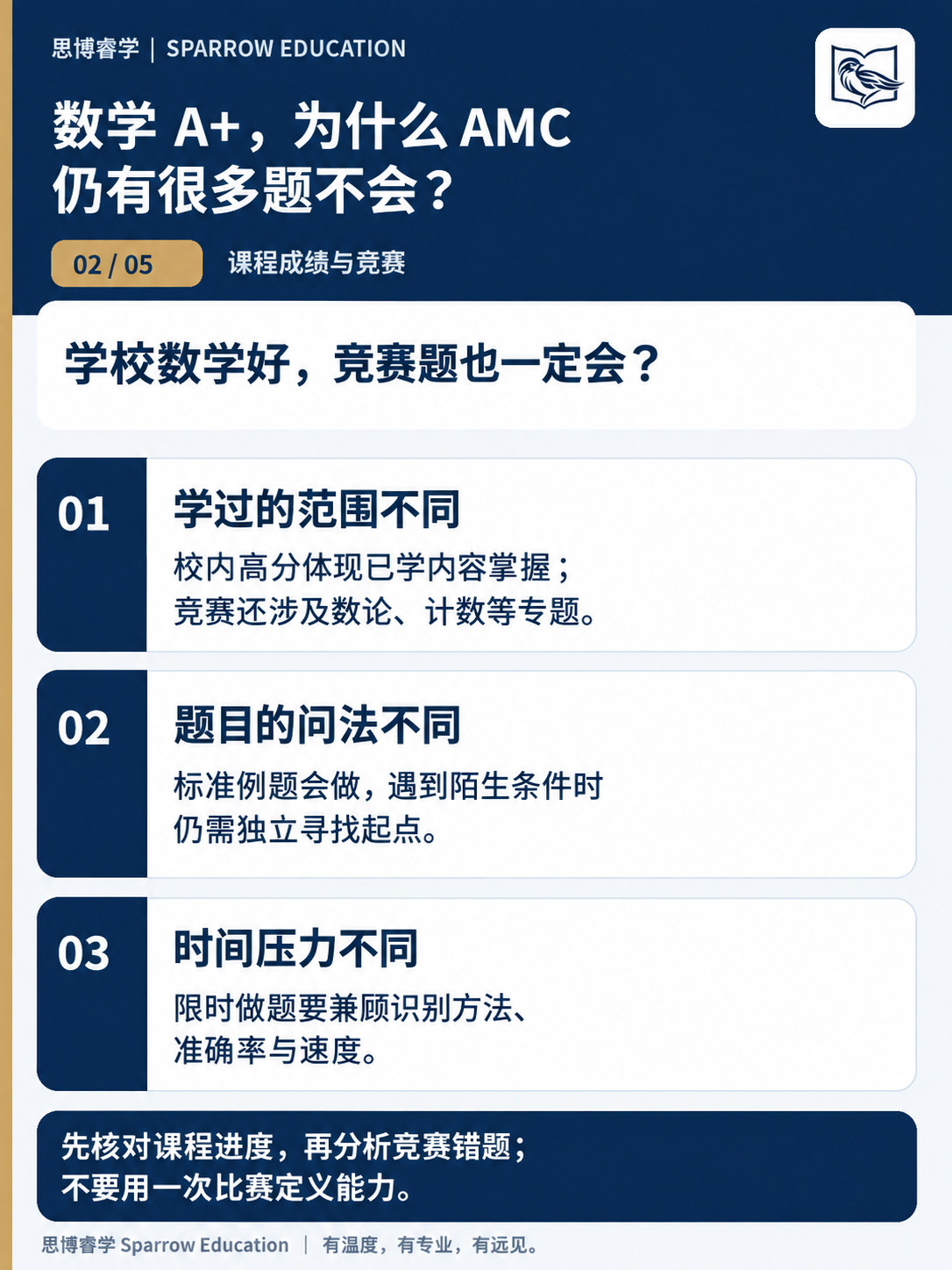
Before deciding how to adjust teaching and practice, we need to check whether the relevant content has been covered, whether students can apply the methods they have learned independently, and whether they can find a starting point when faced with unfamiliar problems.
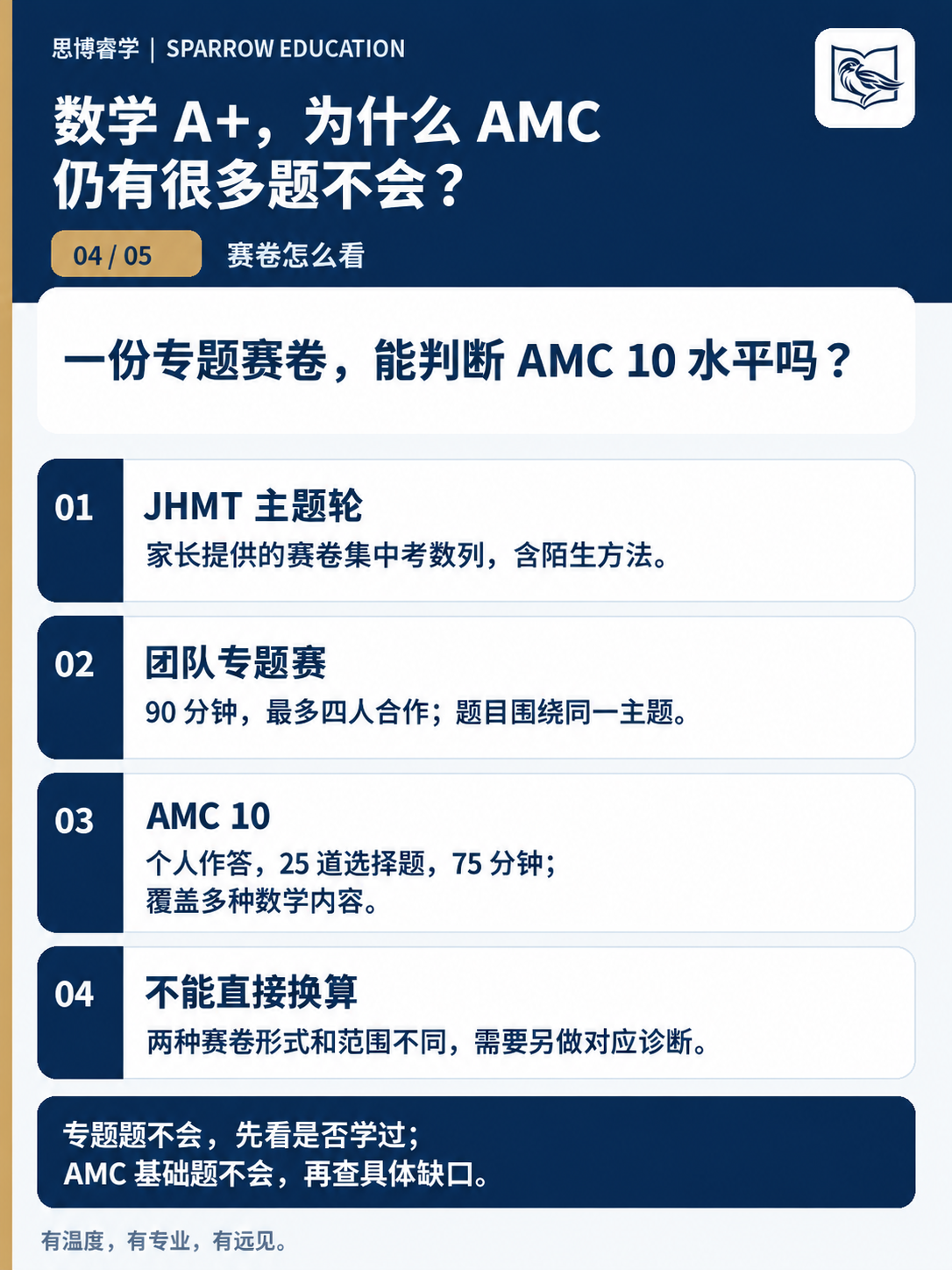
Consider a specific example. The “2025 JHMT China Middle School Team Theme Round” provided by a parent is a 90-minute topic-based maths competition paper for teams of up to four students, focused on sequences. It progresses from arithmetic and geometric sequences to finite differences, Fibonacci sequences and the less familiar Beatty sequences. The questions are arranged by topic, rather than by difficulty.
This paper provides useful clues, but it is not an AMC 10 paper and cannot be used to directly assess a student's proficiency in AMC 10. AMC 10 is an individual maths competition with 25 multiple-choice questions to be answered in 75 minutes, covering several areas of mathematics. Difficulty with the later questions in a topic-based competition may reflect unfamiliarity with the relevant methods; difficulty with foundational AMC 10 topics requires a separate investigation into specific knowledge gaps.
Based on the information currently available, the following points need particular attention:
- Has the content been covered? Simply doing more practice questions will not make up for missing knowledge of number theory, counting or probability that a student has not yet studied.
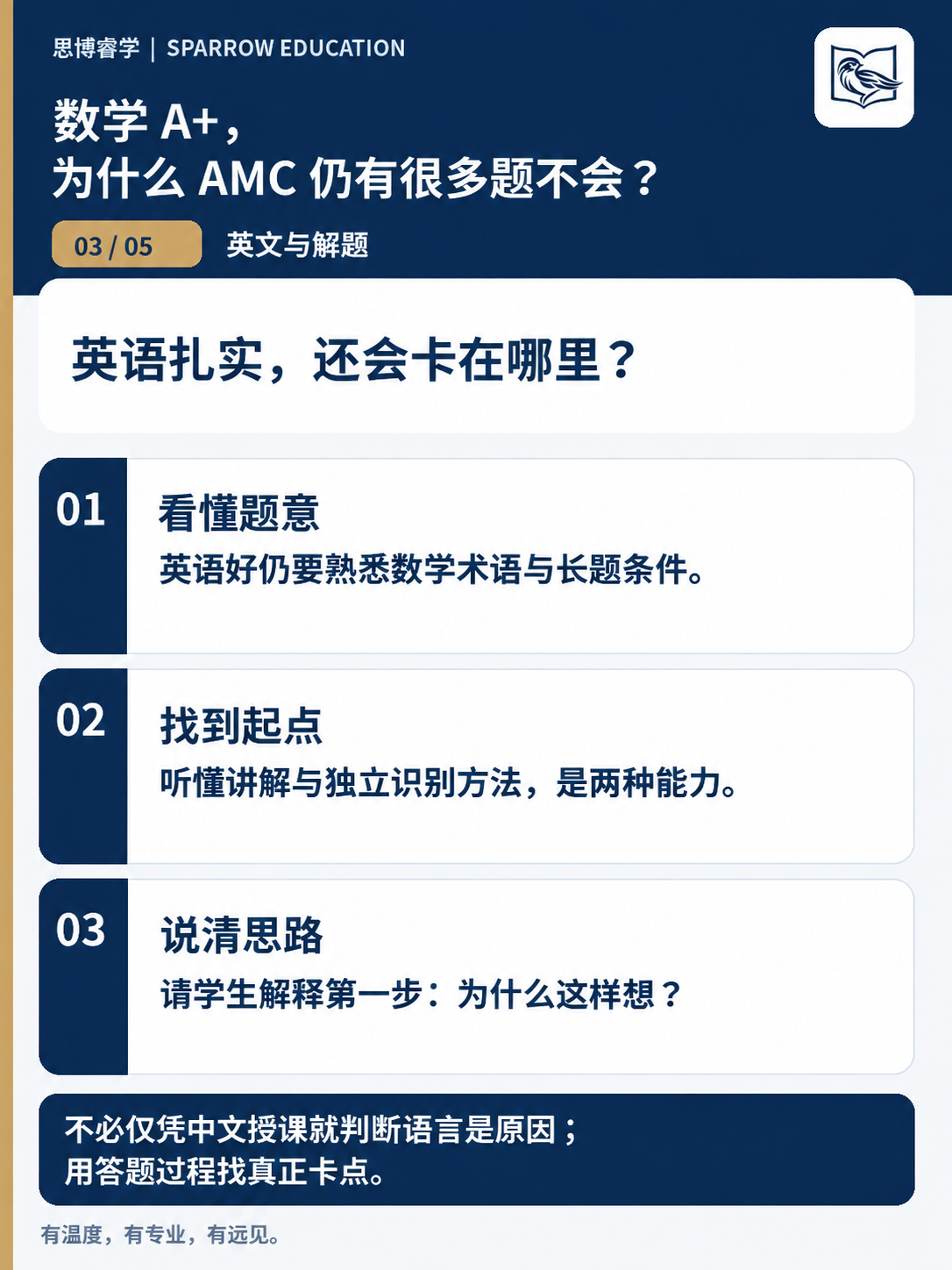
- Can the student start independently? Understanding a teacher's explanation in class and identifying a method independently to solve a variation of a problem are two different abilities.
- Can the student transfer methods? A student who can solve standard examples may still be unsure where to begin when faced with a new definition of a sequence or a problem involving several steps of reasoning.
- Is English actually a barrier? Although the students have strong English, we still need to assess their understanding of mathematical terminology, their ability to break down long questions and their spoken explanations separately. The language of instruction alone is not enough to reach a conclusion.
This is a preliminary analysis, not a final assessment of the students' abilities. There is also insufficient evidence at present to attribute their competition results to the language of instruction.
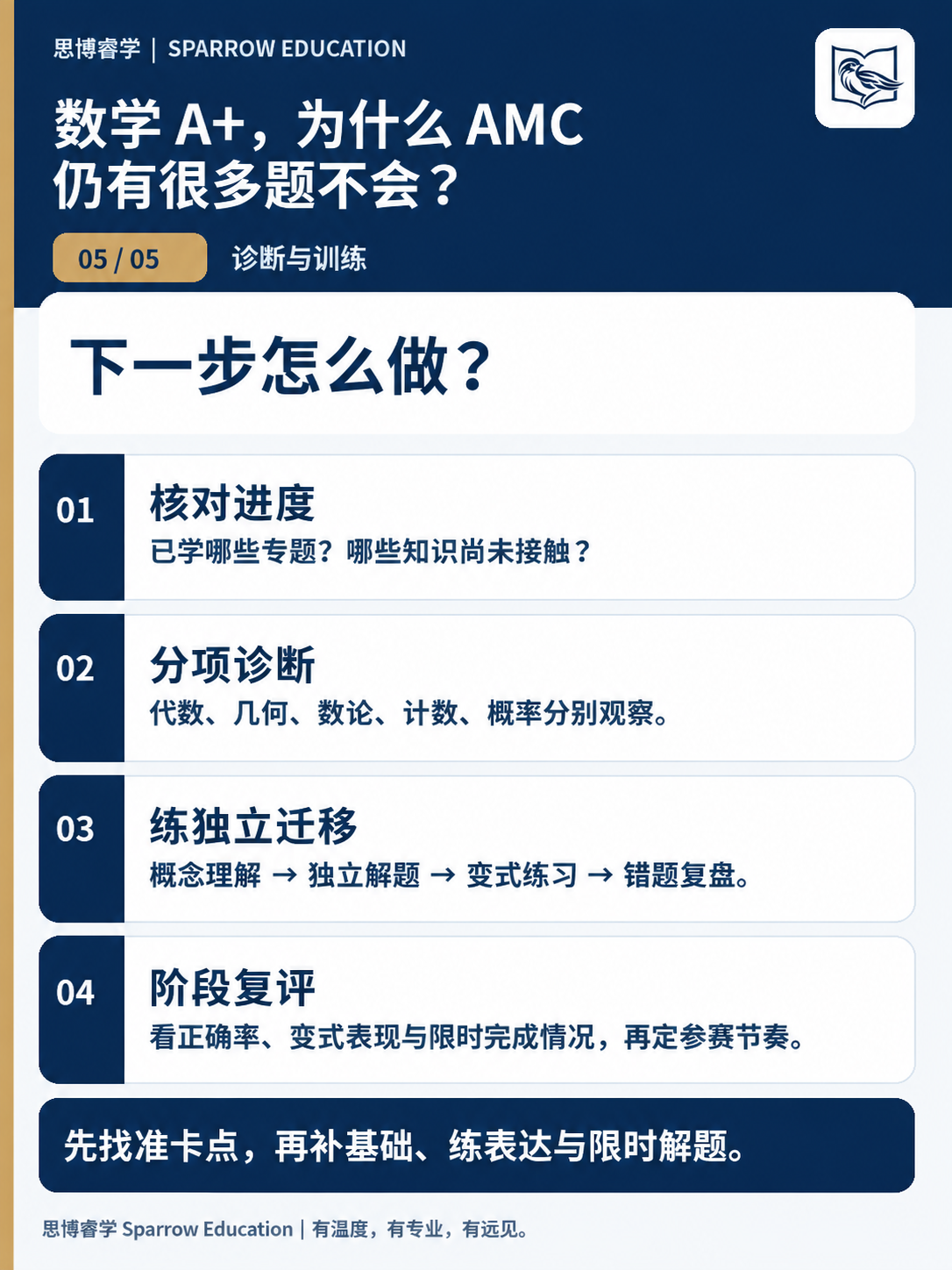
How does Sparrow Education help, step by step?
Step 1 | Review content already studied and previous papers.
Gather information about the student's year group and progress through the curriculum, along with their answers to competition questions and feedback from teachers. Distinguish between “not yet studied”, “studied but concepts remain unclear”, “able to solve basic problems but unable to transfer methods”, and “errors in reading questions or working under time limits”.
Step 2 | Carry out a diagnostic assessment suited to the goal.
Use AMC 10 questions grouped by topic and an appropriate selection of topic-based questions to observe the student's actual performance in algebra, geometry, number theory, counting and probability. Ask the student to explain their first step to identify whether the obstacle lies in the mathematical method or the English wording of the question.
Step 3 | Fill foundational gaps, then introduce problems that combine topics.
First cover missing core knowledge and basic variations of problems. After each topic, follow a sequence of “understand examples—solve independently—apply methods to variations—review errors”. When the foundation is not yet secure, repeated practice with difficult full papers should not replace systematic learning.
Step 4 | Develop the ability to explain mathematical ideas in English.
Chinese can support understanding of new concepts. Gradually use English for definitions and questions in their original English wording, key notes written on the board and students' explanations of their solutions. The goal is for the child to answer independently: What does the question ask? Why choose this method? Is the answer reasonable?
Step 5 | Reassess progress and decide when to compete.
At regular intervals, compare how accurately the student answers questions independently on the same concepts, how well they handle variations, and how much they complete under timed conditions. Then discuss with the student and parents whether the next competition is suitable, and whether the goal should be gaining experience or achieving a particular result.
Experience of maths competitions can provide valuable material for learning. Struggling with many questions in a single competition does not define a child’s mathematical ability, but it can help us identify what to teach next.
Sparrow Education aims to provide families with clear assessment findings and a practical plan for learning: strengthen the foundations and help students gradually build confidence through understanding, explaining their thinking and solving problems independently.
Sparrow Education
Warmth · Expertise · Foresight
Related posters (original Chinese)